
MERN vs MEAN vs MEVN: Which Full Stack Wins In the Future

The world of web development is evolving faster than ever. Businesses today demand scalable, high-performance, and user-friendly applications that can be developed quickly without compromising quality. This is where JavaScript-based full-stack frameworks have become the backbone of modern web development.
Among the most popular choices are MERN, MEAN, and MEVN stacks. Each offers a complete ecosystem for building dynamic web applications using JavaScript, but they differ in their frontend technologies, performance, learning curve, and future potential.
So, which full-stack technology will dominate the future? Let's dive into a detailed comparison.
What Are MERN, MEAN, and MEVN Stacks?
Before comparing them, let's understand what each stack includes.
| Stack | Components |
|---|---|
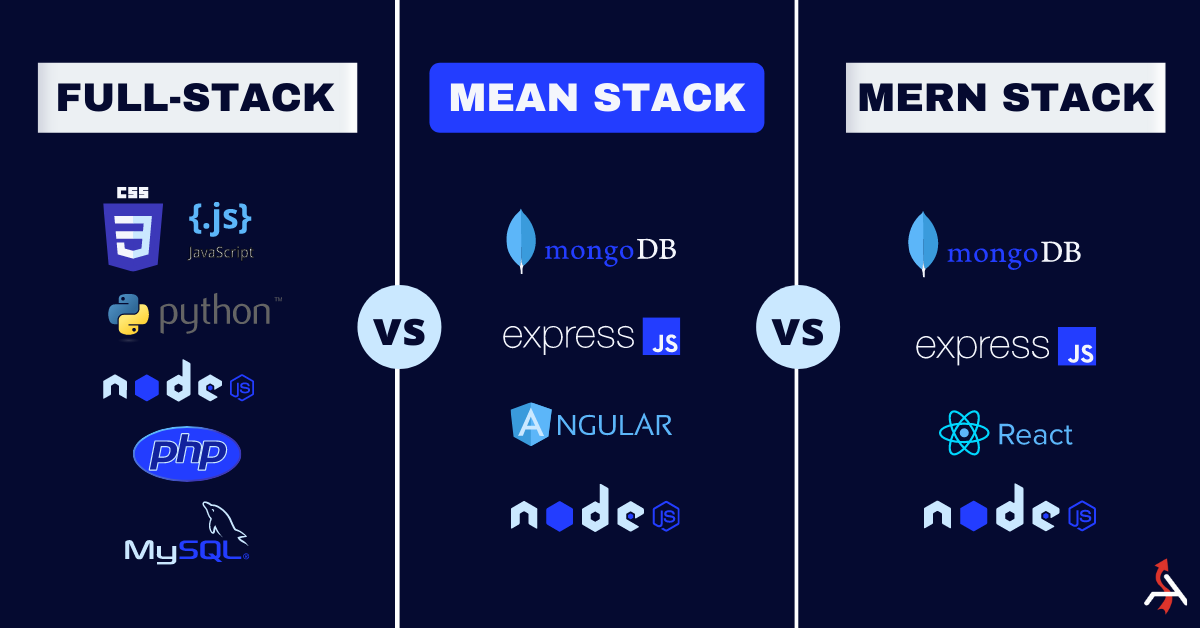
| MERN | MongoDB + Express.js + React + Node.js |
| MEAN | MongoDB + Express.js + Angular + Node.js |
| MEVN | MongoDB + Express.js + Vue.js + Node.js |
Notice that all three stacks share the same backend technologies:
- MongoDB – NoSQL Database
- Express.js – Backend Framework
- Node.js – JavaScript Runtime
The only difference lies in the frontend framework:
- React (MERN)
- Angular (MEAN)
- Vue.js (MEVN)
MERN Stack
Components
- MongoDB
- Express.js
- React.js
- Node.js
Advantages
1. Huge Industry Adoption
React powers some of the world's largest platforms including Facebook, Instagram, Netflix, Airbnb, and WhatsApp.
2. High Performance
React's Virtual DOM makes rendering incredibly fast, resulting in better user experiences.
3. Massive Community
Thousands of open-source libraries, UI frameworks, and developer tools make React highly productive.
4. Flexible Architecture
React doesn't force developers into one structure, allowing teams to build applications their own way.
Best For
- SaaS Products
- Enterprise Applications
- E-commerce
- Social Media Apps
- Real-time Dashboards
- Startup MVPs
Limitations
- Requires choosing additional libraries for routing and state management.
- Frequent ecosystem updates require developers to stay current.
MEAN Stack
Components
- MongoDB
- Express.js
- Angular
- Node.js
Advantages
1. Complete Framework
Angular includes routing, dependency injection, forms, HTTP services, and state management out of the box.
2. Enterprise Ready
Large organizations prefer Angular because of its structured architecture.
3. TypeScript Support
Angular is built using TypeScript, making large projects easier to maintain.
4. Strong Security
Angular provides built-in features against common vulnerabilities like XSS attacks.
Best For
- Banking Applications
- Enterprise Software
- Government Systems
- Large Internal Dashboards
Limitations
- Steeper learning curve
- More boilerplate code
- Larger bundle sizes
MEVN Stack
Components
- MongoDB
- Express.js
- Vue.js
- Node.js
Advantages
1. Easy to Learn
Vue has one of the simplest learning curves among frontend frameworks.
2. Lightweight
Vue applications are generally smaller and faster.
3. Clean Syntax
Developers appreciate Vue's readable HTML-based templates.
4. Great Documentation
Vue provides beginner-friendly documentation that accelerates learning.
Best For
- Small Businesses
- Personal Projects
- Rapid Prototyping
- Medium-sized Applications
Limitations
- Smaller ecosystem than React
- Fewer enterprise-level job opportunities
- Lower adoption among large corporations
MERN vs MEAN vs MEVN Comparison
| Feature | MERN | MEAN | MEVN |
| Frontend | React | Angular | Vue |
| Learning Curve | Moderate | Difficult | Easy |
| Performance | Excellent | Good | Excellent |
| Flexibility | High | Medium | High |
| Community Support | Massive | Large | Growing |
| Enterprise Adoption | High | Very High | Medium |
| Development Speed | Fast | Moderate | Fast |
| Job Opportunities | Excellent | High | Growing |
| Popularity | ⭐⭐⭐⭐⭐ | ⭐⭐⭐⭐ | ⭐⭐⭐⭐ |
Performance Comparison
MERN
React's Virtual DOM minimizes unnecessary re-rendering, making applications highly responsive and ideal for interactive user interfaces.
MEAN
Angular provides solid performance but includes more built-in features, which can increase application size and affect initial load times.
MEVN
Vue's lightweight architecture delivers excellent performance, particularly for small to medium-sized projects.
Learning Curve
MERN
Developers familiar with JavaScript can pick up React relatively quickly. However, mastering concepts like hooks, state management, and routing takes time.
MEAN
Angular introduces concepts such as TypeScript, dependency injection, decorators, and RxJS, making it more challenging for beginners.
MEVN
Vue offers the smoothest learning experience thanks to its intuitive syntax and straightforward documentation.
Job Market in 2026 and Beyond
Current industry trends indicate:
- React developers continue to enjoy the highest demand across startups and enterprises.
- Angular remains a strong choice for large organizations and enterprise software.
- Vue is steadily gaining popularity, particularly among startups and smaller development teams.
For aspiring full-stack developers, MERN generally offers the widest range of career opportunities.
Which Stack Is Best for Different Projects?
Choose MERN if you want:
- Startup development
- Scalable web applications
- High-performance user interfaces
- Strong community support
- Better freelancing opportunities
Choose MEAN if you need:
- Enterprise software
- Long-term maintainability
- Strict architecture
- Large development teams
Choose MEVN if you prefer:
- Rapid development
- Simple learning curve
- Lightweight applications
- Small to medium-sized projects
Future Outlook
MERN
React continues to dominate frontend development, supported by a vast ecosystem, continuous innovation, and strong industry adoption. The MERN stack is expected to remain a leading choice for modern web applications.
MEAN
Angular is likely to maintain its position in enterprise environments where consistency, scalability, and maintainability are priorities.
MEVN
Vue's popularity is growing steadily, especially among startups and developers seeking simplicity. While it may not surpass React in the near future, its adoption is expected to increase.
Final Verdict: Which Full Stack Wins?
There is no universal "best" stack—each excels in different scenarios. However, considering current industry demand, community support, ecosystem maturity, and career opportunities:
🥇 MERN Stack emerges as the strongest all-around choice for most developers and businesses.
🥈 MEAN Stack remains the preferred option for enterprise-grade applications requiring a structured framework.
🥉 MEVN Stack is an excellent choice for developers who value simplicity, speed, and an enjoyable development experience.
Ultimately, your decision should align with your project requirements, team expertise, and long-term goals. If you're aiming for maximum versatility and career growth, investing in the MERN stack is a smart move. If enterprise development is your focus, MEAN is a solid contender. And if you prioritize ease of use and rapid development, MEVN is well worth exploring.
Conclusion
The future of full-stack development is increasingly JavaScript-driven. Whether you choose MERN, MEAN, or MEVN, all three stacks provide powerful tools for building scalable, modern web applications. While React currently leads the market, Angular and Vue continue to evolve, ensuring developers have strong options for a variety of use cases.